Monday, March 23, 2015

A New Adventure

Truth be told, my fishing suffered severely in 2014.  That's the bad news.  The good news is that my upland hunting increased exponentially, due to my new hunting companion, Toby, the Field Bred English Springer Spaniel.


In the fall of 2013 he was but a wee lad, but Toby has grown to be a 43 lb. ball of energy and instinct. People love him.  Birds fear him.


Although I've had dogs all my life, Toby is my first Springer, and this has been my first crack at training a bird dog.  Knowledgeable friends, good books, the internet, a heavy dose of persistence, consistence, and patience, can give even a dog training novice a crack at satisfactory results these days.

With all bird dogs, but particularly with the flushing breeds like Springers, obedience is the real key. The instincts are in there...at least you hope they are, once you've convinced your wife that a well bred dog, and all the associated equipment and veterinary costs are well worth the investment.  The real trick is to develop an obedient dog that will willingly work with, and for, you.  If he'll work close, resisting the urge to work too far out in front of the hunters, and come when called - his nose, a natural drive to hunt, and his natural desire to retrieve, can be directed toward the fun and enjoyment of you and your hunting companions.

We first hit the bird fields when Toby was 7 months old.  A knowledgeable friend with a well-mannered Springer helped us navigate the maiden voyage.  Toby did an admirable job of finding and retrieving planted chukars.  It was clear he had the right stuff, and the self-applied pressure increased as the little voice inside my head said "You're clearly the weak link in this relationship...try not to screw it up".

Successful first hunt

A long summer of field work, obedience training, and fun followed.  Working to train a pup to voice and whistle commands is highly rewarding.  A good bird dog pup's desire to please is remarkable, and fun to harness. Watching your pup paddle eagerly to a dummy you just launched to the middle of the farm pond, and return to your side with equal enthusiasm, before dropping the dummy in your hand, is a fantastic feeling that swells your chest with pride.  With Toby's affinity for the work and desire to please, I knew that when training sessions didn't go well, It was likely my fault.
  
As summer wound down, dove season was the first opportunity to put Toby on birds, and several trips afield produced a handful of opportunities.  It was obvious that Toby's retrieving skills were better than my wing shooting skills, as the pup found each bird that was knocked down and brought it to hand.  Occasionally, he would look up at me, as if to say, "How come you're shooting, but no birds are falling?"  Fortunately, bird dogs have short memories in regard to these matters, and have no desire to tease you about your misses (this is not true for all hunting buddies).

October brought a wonderful opportunity for Toby and me, as we headed north to Maine with four other dogs and 10 good friends.  For more than a week, we chased grouse and woodcock from Millinocket through the North Maine Woods.  The outpost camp we rented through Libby Camps was a fantastic home base for some self-guided bird hunting fun.  We stopped at the main lodge on our way to camp, to share lunch, gas up, and pick up some navigational and hunting tips. The Libby's are raising the sixth generation of capable hosts and guides, and their love and knowledge of the North Main Woods is second to none.  

Toby grew a great deal as a hunter that week, overcoming a nasty cut on one of his pads to work with other dogs, and for other hunters.  Daily construction of a booty made of duct tape made it possible for Toby to hunt.  Each night, protective gear removed, he went back to using three legs.  Each morning, after being taped up, he hit the woods in four-wheel drive.  By the end of the trip, Toby had added grouse, woodcock and a nice water retrieve on a duck to his resume'. 

Five dog mobile home

Mooseleuk Lake, North Maine Woods

Scouting the Lake

Wood fired cookstove - Grouse Hunting Palace

Endless logging roads through prime habitat

Gettin' the job done
Back home in Pennsylvania, with shorter, cooler days, came the opening of pheasant, grouse and woodcock season in Pennsylvania and we had great fun canvasing local PA State Game Lands for stocked pheasants. Pennsylvania has ramped up its pheasant stocking program in the last number of years, and, while I find a greater satisfaction in hunting wild birds, it is hard to argue with the opportunity to chase some surprisingly wary birds so close to home.


After school adventures

I also came to more fully appreciate what a wonderful family sport upland hunting can be.  My seven year old son and ten year old daughter love to follow Toby in the field and watch the birds rise with the Springer nipping at their heels.  The young apprentices were also eager to carry the birds, when we were lucky enough to bring them down.  This is always a welcome trait in a hunting partner. With a small area of stocked Game Lands five minutes from home, we can head out right after school, hunt for an hour and a half, and still be home for supper.  Bringing home happy, tired kids and a happy tired pup wins me brownie points with my wife.  Brownie points for hunting...what a concept.

Snowy Thanksgiving  Day hunt

All in all, it was a great hunting season.  We hunted from September through January, and Toby logged flushes and/or retrieves on grouse, woodcock, chukar, pheasant, doves and ducks. There is still work to do, but Toby is just getting up to speed - he will turn two as hunting season approaches late in 2015.  He'll need more practice afield, and more training, to resist the urge to punch out too far when birds are running, or hard to come by, and to resist the urge to give chase when his master blows the shot.  Just because your dog heeds the whistle in the back yard, is no guarantee he'll obey when the birds are flying and the guns are sounding.  Repetition and consistency are key.  I'll also look for more opportunities to put Toby on waterfowl, where he can exercise his strong drive for water retrieves. I'm determined to make the time to help him realize more of his potential, knowing that he will repay me with years of good hunting and companionship.                             

              
                                     Toby doesn't let high water slow down a good pheasant retrieve

I've come to see quite a bit of similarity between fishing and hunting upland birds with a dog.  When fishing, I carry the rod and cast a lure or fly toward promising targets.  While hunting, I carry my shotgun and cast my dog toward promising cover.  In both cases, it is necessary to read the water/terrain, find the likely spots and be ready for the action when it comes.  In fishing, the take is the ultimate moment.  Similarly, the flush of upland birds is the moment you anticipate most. Bringing a fish or bird to hand is the end goal of the adventure, but in both cases, that's not what keeps you coming back.  It's the planning, the preparation, the anticipation, the friendships you develop, and the outing itself.  Getting there is more than half of the fun.  If only catch and release were an option while bird hunting...  

Fortunately, game birds are delicious.


Wednesday, September 18, 2013

The More Things Change…

I’m not a total dinosaur, but I do consider myself a traditionalist.  As the gray in my beard overtakes the darker shades, I prefer to catch fish on a fly rod, hunt deer with a longbow, and wear wool as often as possible.  I wear practical wide brimmed hats when afield, to keep the sun off my face in summer and snow outside my collared shirt in winter.

I’m not a total throwback, mind you.  Contrary to those traditional leanings, I do find the internet a wonderful tool for the sportsman.  I keep tabs on a couple good fishing blogs and e-magazines, and I find the internet a wonderful tool for planning trips, investigating aerial images, and researching guides and outfitters in areas new to me. 

In this perusing, I am now frequently noticing that sportsmen don’t look much like they used to.  It strikes me that many outdoor films are starting to look like boy band videos.   Carefully planned shaggy hair, flat brimmed ball caps set slightly askew, and synthetic wicking fabrics emblazoned with energy drink logos are the order of the day.  Combined with the fact that one can now obtain professional quality video equipment small enough to strap to a fishing rod, surfboard, ski pole, straight brimmed ball cap; or anything else that remains rigid long enough to capture the fight, wave, run, kill or crash.  Edit the experience together with appropriately raucous soundtrack, and post online for the whole world to absorb your attention-worthy aura.  Now you’re really somebody.

I realize that Fred Bear, Marlin Perkins and Curt Gowdy haven’t been around for a while and, truth be told, my wanderlust as a tenderfoot was fueled by Babe Winkleman and Bill Dance as much as it was fueled by those old masters.  While not exactly mountain men, Babe and Bill at least knew that a flannel shirt and cup of coffee were camp essentials, as opposed to a hoodie and a shot of 5-hour energy.

I had been bemoaning this state of affairs for some time, smugly acknowledging that my traditional sensibilities were mildly superior to those extreme athletes turned outdoorsmen.  Then, one day at the family hunting cabin, sorting some gear for the approaching archery season, my father began to comment on how many new-fangled do-dads are now required to pursue game afield.   “Here we go”, I thought.   It was true that my father did not have the benefit of portable tree stands, scent eliminating boot spray, or scent producing doe in estrus scent drags; but surely he would have utilized these tools had they been available.  Wicking base layers join wool outwear like apple pie joins ice cream.  And so what if I had three pairs of hunting boots, designed for various seasons and terrain.

“Dammit! I was one of them, 20 years ago!” I thought to myself. 

I didn't want to give my father the satisfaction of knowing he had a point, but it dawned on me that things are no different today than they have ever been.  Some smokepolers probably cast a critical eye on brass cartridges and lever actions.  Split cane casters likely bemoaned fiberglass, and then graphite. 

As I begin to share a love of the outdoors with my young children, I think more about the really important things:

  • The love of natural systems – all the parts – not just the target species, or the charismatic ones
  • An appreciation for humility – knowing that we don’t know it all and knowing that quiet observation is often the best instruction
  • An appreciation for enough – enough for today, enough for the season, enough for the next generation
  • An appreciation for conserving the resources and preserving the landscape that produces the resources
  • An appreciation for the benefits of preserving truly wild places, where people are rarely, if ever, seen

 Perhaps the hipsters and the X-gamers are getting those things.

I just wish we could discuss it without a soundtrack...off-camera…with a cup of coffee.

Tuesday, May 7, 2013

Big Fish

Spring has sprung, and so has the carp fishing in central PA...

With spring as busy as usual, there has been precious little time to hit the streams, rivers and lakes here in my rural part of the Ridge and Valley region.  The itch to fish was beginning to get the better of me when, about 10 days ago, I was passing by a farm that is home to one of my favorite carp honey holes.  I only had a 5 wt. fly outfit in the truck, but I did have some carp flies, and there was storm front moving in, so I thought perhaps the carp would be feeding.

They were feeding, alright.  In fact, one carp was so eager to eat that I watched him move more than 18 inches to devour my crayfish fly.  30 minutes later, I had enjoyed two great tussles with healthy carp, and the rain was bearing down.  There were a couple larger specimens, but I couldn't get the fly in front of them.  That may have been for the best, as I suspect they might have converted my 4 piece, 5wt. to a 6 piece, paper weight.


These two will put a bend in the 5 wt.

That brief outing satisfied the fishing itch for a week or so, but soon enough, I felt the need to break out the canoe and look for some bigger fish in bigger water.  With my capable first mate in tow, the canoe was loaded in the truck and we headed for a nearby lake where carp were known to be numerous and of good size.


First Mate

Unfortunately, the shallow flats were discolored due to wind, feeding fish, or both.  Carp could be found, but usually as the canoe passed over, or very near, the fish.  A couple feeding fish were spotted in time to muster a cast, but a waving rod, or ill placed piece of woody debris, foiled my limited attempts.

After two hours of poling and blind casting, it was just about time to head back to the truck...the first mate had a friend's birthday party to attend and we weren't to be late...when a couple larger fish were spotted feeding in the shallows along a flooded road bed. The wind picked up considerably, making boat placement difficult, but the trolling motor did it's job, and a few reasonable casts were taken.  

In the cloudy water a take was difficult to discern, but with approximately the right amount of leader between the fly line and the fish, and a telltail wiggle, a firm strip set resulted in the kind of golden roll that flycarpers live for.  

Line flew through the guides as if we'd hooked a trophy permit.  As the behemoth made several long runs and generally had its way with the canoe, a timely arrival at the aforementioned birthday party seemed unlikely.  With time of the essence, I played the fish as hard as my inexpensive 7 wt. rod would allow.  Just shy of 20 minutes later, the carp was boatside and I snapped a quick picture, explaining to the first mate that we probably weren't going to bring this fish into the canoe.  

Sidebar:  15 years ago, I had a bad experience along the coast of southeast Alaska with a small skiff and a large halibut.  Another greenhorn and I had just boated a decent 60 lb. halibut (How were we supposed to know you were to shoot 'em and tow 'em home?) Had it not been for the hammer we found under the seat in that boat, and several rounds of slimy hand to fin combat, my friend and I might not have lived to tell the tale.  

I have been leery of loose fish in tight places ever since.

Back to the carp...

The "Large" Measure Net I carry in the canoe is capable of measuring a 28" fish - gloriously inadequate.  


I knew the fish had plenty of strength left, but miraculously, it surrendered with dignity, and lay perfectly still as I lifted it aboard for a quick cell phone picture and a smooth release.  Unfortunately I had left my 50 lb. scale in the truck, although, without a larger net or weighing bag (which I will be acquiring), I don't think I could have managed the weigh in.

Official length:  damn long.
Official weight: damn heavy.
Official emotion: damn happy

Icing on the cake:  Made the birthday party on time


Friday, February 8, 2013

River Sojourn

Winter is wonderful.  It allows the body and mind time to renew, in preparation for the more active pursuits of spring.  This winter, as with most, I have been dreaming of canoeing, camping and fishing.  

I've decided that the kids, now 8 and 5 years old, are ready for some more adventurous canoe camping, when the weather, and waters, warm to a more suitable temp.  They have done their share of canoeing and fishing, but camping has been primarily of the car variety, and, while car camping has it's own charm, it doesn't have the single most important charm that first led me to camping - the ability to get away from large numbers of people.  

So this winter has found me restocking and supplementing the camping supplies to include gear that is a little lighter and a bit more waterproof/water-friendly.  Most important among the list of new acquisitions are a couple Rubbermaid Action Packers, which are about the most cost-effective durable weatherproof storage I have found, and a somewhat adequate substitute for the more traditional canoe wannigan.  

I found myself thinking of a trip we took a couple years ago that was our first foray into canoe camping with kids.  I pulled up a few photos to reminisce, and, remembering the trip also involved some good fishing, it seemed appropriate to catalog it here.

We were taking part in the Juniata River Sojourn, an annual event here in central PA.  The event is sponsored by the Juniata Clean Water Partnership and is a well planned float and camping adventure that you can participate in for a day or two, or the entire five or six.


Meals, interesting stops and presenters are included, camping is pre-arranged, and your camp supplies are ferried ahead by vehicle to minimize the gear you must carry in your canoe or kayak.  Safety is a priority and the trip includes qualified guides/safety staff.  

Similar sojourns occur all over the U.S. and are a great way to introduce kids and less experienced adults to joys of paddling and camping.

A motley crew, ready to launch

Paddling in a group can be quite a social event...
...but even group trips provide moments of serenity


No better way to cool off than to abandon ship for a while

My daughter, about to turn 6 at the time, paddled like a champ for hours.  As we prepared to coast ashore at our campsite, she closed her eyes and learned one of the best rewards of a hard day's paddle - the ability to sleep well...even sitting up.

Out of Gas
Home Sweet Home

Fishing was not a priority for this trip, but I can't be in a canoe without a rod, so I did some lazy fishing as we went.  The sky was high and the sun was strong.  Flows were about average for June and the water was quite clear.

As we pushed off in Lewistown, PA, after lunch at the town park and a short presentation on local history, I found myself waiting for the rest of the armada to launch.  I grabbed my trusty medium light spinning rod and threw a small jerk bait directly at the upstream side of concrete bridge piling.  A jerk...a pause...WHAM!

After an exciting fight, during which the smallmouth headed for the bottom of a deep hole and then launched an aerial assault, in an attempt to throw the lure, I brought to hand a hefty piece of Juniata River smallmouth measuring 21.5".  I've fished this river off and on for 20 years and this fish was a personal best, and good enough for an official citation from the PA Fish & Boat Commission.

A great trip, and a reminder that the best fishing can sometimes strike when you least expect it.

Happiness.


Friday, July 13, 2012

Pennsylvania River Carpin'


Headed for the river early Sunday morning after a bit of a hiatus for work and family activities, including some time at the beach.  Sitting on the beach is relaxing...to a point, but upon my return to the real world with one day to catch up on all those post vacation chores, I woke up with the sun and headed for the river, for my kind of relaxation.

Ghost carp stalks the skinniest water

Signals were mixed as I worked my way across the growing gravel bar.  Two weeks of searing heat and sparse rain showers had the river shrinking rapidly.  It was obvious carp were, or at least had been, present, but it appeared as though one carp refused to move to deeper water, and had paid the ultimate price.  Of  course appearances can be deceiving, but I believe some carp may be stubborn enough to allow that to happen.

Carp were not tailing in the skinny water as they had been at this spot in years past, but as I reached the long deep pool below the skinny water, I began to see carp, some large, cruising in groups of 3-6.  After a painful number of refusals, I took the hint and changed flies.  The small conehead olive wooly bugger I tied on more closely matched the color of the river water and, almost immediately the fly was getting more attention - mainly from the small smallmouth and rock bass abundant in the river, but soon enough a group of cruising carp took notice of these small eager fish fighting over this apparently tasty morsel.  The biggest bruiser in the bunch decided to beat her buddies to the treat and gobbled down the fly with such gusto that I nearly forgot to set the hook.  Nearly.


After 10-15 minutes (time flies when you're having fun) and one long run into my backing, the brute was brought to hand.

Poor cell phone photography aside, a handsome fish indeed

Put a good bend in the 7 wt.
Nice tail.

The Release - almost as satisfying as the take

Can't wait to get out and try for some more.  A family trip to Maine, to visit relatives and Acadia National Park, will keep me off the river for a  bit, but will hopefully afford some good bass fishing as well.

Fish On.


Tuesday, July 10, 2012

Get a Grip


Being relatively new to the fly-carpin' game, preferring to travel light, and prone to wandering rivers on foot, I haven't found a net set up for wading that I like, but I admit a net is a good idea.  I'm very intrigued by Mr. P's recent article "Nettin' Carp Like a Gunslinger".  

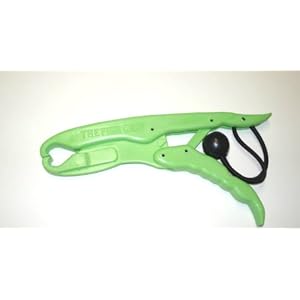
I'm an advocate of landing a fish before it is entirely exhausted and I do my very best to handle fish gently, and quickly, before releasing them.  Additionally, I like any excuse to buy another piece of fishing tackle.  For those reasons, I'm likely to soon acquire a net for fly-carpin' on foot.  In the current absence of a net I am having good luck using The Fish Grip, a tool that I find to be head and shoulders above the better known, and more expensive, Boga Grip.

The Fish Grip Green
Fish Grip above, Boga Grip below


The locking mechanism of the Fish Grip is more like a Vise Grip than a Boga Grip and, with its smooth jaws, the Fish Grip can be pinched behind the front or corner of the a carp's bugle like mouth to more gently, and securely, hold the fish, in the water, while a hook is removed or a picture is taken.  The Boga Grip has a built in IGFA certified scale, but a carp needn't, and shouldn't, be lifted by the lips, so the scale isn't a plus to me, at least with carp.

Oh, yeah...and the Fish Grip... 
  • is available in a variety of cool colors
  • costs $12, rather than $120 like the Boga Grip
  • weighs a fraction of the Boga Grips weighs - making it handy to travel, and wade, with
  • it floats (the Boga Float will run you another $15)
  • can be easily be carried by clipping to your vest, belt loop, shirt, or nipple ring.

Both Grips are made in the USA.  

The Boga The Boga Grip does have a pivoting head which, sellers emphasize, allows fish to be revived in the water.  I suppose a pivoting head would have some advantages, but I've never had any trouble reviving a fish with the Fish Grip, and I have seen several complaints that the Boga's pivoting head results in some tremendous line tangles when trying to land and unhook large feisty specimens.

One of the best features of the Fish Grip is the extra safety factor afforded when removing treble hooks, and the fact that kids can use it when removing hooks or posing for that fishy shot with panfish or bass.

The Fish Grip helps Henry get a handle on a farm pond bass


Give the Fish Grip a shot and let me know if you're as happy with it as I am.

Sunday, May 6, 2012

Another Type of Flats Fishing Trip


I put the carp flies on the shelf last week and headed for Havre De Grace, MD for a different kind of flats experience.  A Baltimore based fishing buddy and I had been attempting to get a good trip to the Susquehanna Flats for over a year.  The weather had proved to be our nemesis - but finally the stars aligned.

If you haven't heard of the striped bass fishery at the mouth of the Susquehanna River, and the top of the Chesapeake Bay, you are not alone.  The fishery is gaining notoriety quickly, however; as steady supplies of stripers, or rockfish as they are locally known, and a special catch and release season on the flats, combine for an amazing opportunity.

Over seven square miles of flat water, averaging about 4 feet deep, with little to no structure, can be an intimidating site, particularly when you factor large grass beds just under the surface, tidal influences and the distinct possibility of running a larger boat aground if you don't have the necessary knowledge of the area.

Stripers have a fascinating life history and migratory route.  Most will winter off the coast of the Carolinas and follow the coast north, up through the coast of northern Maine, through the summer months, to stay on the feed and in their comfort range of 55-68 degrees.  Perhaps the most important stop on the way is the Chesapeake Bay and its tributaries where the fish gather to spawn and put on the feedbag.

The Susquehanna Flats, around about the month of April, offer one of the best chances to get up close and personal with these great fish, using light spinning tackle and fly rods.

Capt. Jeff Lewatowski was our guide of choice.  Jeff is a great fisherman with tremendous range.  He has fished a lot of water, including a stint guiding in Alaska, but now plies his native Maryland waters professionally, chasing everything from fly-rod trout in the Gunpowder River to flounder, tautog, sea bass, and stripers in the salt, near Ocean City, MD.  Whatever he is fishing for, he likes light tackle and fly rods.

Capt. Jeff, in the foreground, knows the flats like the back of his hand.
 In fact Jeff's only flaw seemed to be his skepticism for carp on the fly.
Spoken like a fellow who never tried it.
In 2011, we tried repeatedly to get a Susquehanna Flats trip together, but record rainfall blew the flats out for more than a month, and the entire season was a loss.  Spring 2012 brought much more cooperative/drier weather and the bite was on again.  It still took us three tries to hit a day when the fish were there and the wind/rain was not, but it was worth waiting for.

This one put a nice bend in the 8-wt.
The fishing was good and the weather was great.  Light winds and temps in the 50-65 degree range allowed us to get the fly rods out.  We used spinning gear with 12 lb. test mono to cover a lot of water quickly and dial in on pods of agreeable stripers.  It took a couple hours to find the right spots, but we boated about 30 stripers, which included about 10 on the fly.  It looked like most boats we saw were struggling for bites, but Capt. Jeff had us drifting through enough fish to keep us smiling all day.  Big Lefty's Deceivers were the fly of choice, and when those fish hit, they took care of the strip set for you, including some great takes, right at the boat.  I should have taken more pictures, but when the bite turns on, they can come fast, and furious and holding a camera is the last thing on your mind.


Finished up with the best of the day

We weren't able to lure the biggest fish into striking that day - fish in the 35-45 inch (16 - 40 lb.) class are not uncommon - but after fighting a couple 10-12 pounders, I can hardly imagine a 40 pounder on the fly or, on the perfect day, on a popper.

OK...I can imagine it...and I want it bad.

Capt. Jeff's 23 ft. Parker was a very nice fishing platform.  Ryan works the drift.

On a Carpy note, Capt. Jeff did happen to mention that his boat brought in a 30 lb. carp on a jig earlier in the season.  He then sent me the picture below.  I think I feel another outing coming on later in the season.

Susquehanna Flats Carp